
NeuraActive™
Activity Recognition & Tracking
Licensable Edge AI for Fitness, Sports & Health Wearables.
Near 100% Accuracy, Production-Proven in the Extreme
Conditions of Olympic Sports & Medical Devices.
NeuraActive uses your existing IMU data to detect daily activities, sports performance, clinical motion, gestures, and more. All processing runs on your microcontroller with sub-millisecond execution time, ensuring motion analysis stays synchronized with the activity for real-time feedback and control.
Everyday Motion
• Step Counting (Pedometer)
• Pedestrian Dead Reckoning (PDR)
• Activity Classification
• Toothbrushing Assistance
Sport & Fitness
• Walking/Running
• Cycling
• Weightlifting
• Golf
• Roller Skating
• Ball Sports
• Water Sports
• Winter Sports
• Olympic Sports
• Combat Sports
Health & Biomedical
• Gait Analysis
• Neurorehabilitation
• Injury Prevention
• Movement Disorder Assessment
• Exoskeleton Control
Human-Machine Interface
• Gesture Recognition
• Head Tracking
• Handwriting Recognition
Custom Development
Need an activity we don’t recognize? We can build it.
Examples of What You Can Do with NeuraActive
PEDESTRIAN DEAD RECKONING
Continuous Indoor Positioning
Tracks position and movement using IMU data only by monitoring steps, heading and stride patterns in real time. Powers accurate navigation in GPS-denied environments such as shopping malls, airports, parking garages and warehouses.
HANDWRITING RECOGNITION
Scripting on the Edge
Recognizes handwritten characters and strokes by leveraging IMU data in real time. Enables natural input for wearable devices, sensor enabled gloves and smart pens, turning any surface into a responsive writing surface.
GAIT ANALYSIS
Biomechanical Assessment
Extracts stride, cadence and symmetry metrics from pre-processed inertial sensor streams in real time. NeuraActive runs edge-optimized analytics on this clean, zero-drift data to deliver accurate movement insights for health monitoring, fall detection and performance assessment.
GOLF SWING ANALYSIS
Real-Time Swing Intelligence
Captures and analyzes key swing mechanics such as club speed, swing plane, club trajectory and rotation of the club. NeuraActive monitors this data locally to generate precise, low-latency insights, allowing you to monitor technique in real-time and track performance improvements.
Use Cases
Customers use NeuraActive to convert inertial data into interpretable activity insights that support performance analysis, behavior tracking and interaction monitoring.
In sports and fitness environments, NeuraActive enables reliable recognition of movement patterns across diverse activities, supporting metrics such as gait periodicity, stride dynamics and sport-specific motion signatures. It also enables Pedestrian Dead Reckoning (PDR) for trajectory estimation in settings where external positioning is unavailable.
Beyond activity classification, NeuraActive supports gesture recognition for human–machine interaction, enabling intuitive device control based on natural movement. Running directly on embedded IMU platforms, NeuraActive provides consistent inference using limited computational and power resources, making it well suited for integration into battery-powered wearables and motion-aware consumer devices.

SPORTS EQUIPMENT

FITNESS
TRACKER

SPORTS PERFORMANCE

PEDESTRIAN DEAD RECKONING

CLINICAL RESEARCH

BIOMEDICAL REHABILITATION

VR &
GAMING

ANIMAL
TRACKING
SPORTS EQUIPMENT
FITNESS
TRACKER
SPORTS PERFORMANCE
PEDESTRIAN DEAD RECKONING
CLINICAL RESEARCH
VR &
GAMING
BIOMEDICAL REHABILITATION
ANIMAL
TRACKING
Why Choose NeuraActive
NeuraActive has been validated in some of the most demanding motion applications, from precision analysis of Olympic athlete performance to a medical-grade neurorehabilitation system that earned Class I Medical Device certification. These applications required accuracy levels that generic activity tracking libraries cannot deliver. That same precision now ensures consistent accuracy across all NeuraActive deployments.
Performance You Can Rely On
Near-100% accuracy proven in applications where precision determines product success.
Fast to Market
From kickoff to edge AI on your device in weeks instead of months.
No Cloud, No Tuning
Everything runs locally with complete privacy. No retraining, no setup, no personal data leaves the device.
Expert Support
Direct access to the NeuraActive engineers, with deep technical expertise and responses typically within 24 hours.
What Makes NeuraActive So Accurate?
NeuraActive achieves near-100% accuracy by combining physics-informed AI with expert tuning. Our engineers refine the ML models using real-world movement data from humans and animals through an expert-in-the-loop approach.
To ensure reliable performance in diverse conditions, NeuraActive applies a multi-stage processing pipeline. This layered approach handles sensor limitations, filters false positives, and delivers consistent real-time intelligence.
Pre-Processing
Raw sensor data is first filtered through precision sensor fusion to prepare it for downstream analysis.
Edge AI
The filtered data is then analyzed on-device using ML models refined through expert-in-the-loop training. During this stage, NeuraActive detects and classifies motion in real time.
Edge Post-Processing
Finally, validation logic verifies the insights and refines the output to ensure it remains consistent, accurate & aligned with physical human actions in real time.
NeuraActive Key Features
Precision Edge AI
Embedded algorithms that deliver accurate insights under high and low dynamic conditions
| 221e Dataset | PAMAP2 Dataset | |||||||
|---|---|---|---|---|---|---|---|---|
| Activity | Static | Walking | Running | Cycling | Static | Walking | Running | Cycling |
| Carry position | Foot, ankle | Foot, ankle | Foot, ankle | Foot, ankle | Ankle | Ankle | Ankle | Ankle |
| Accuracy [%] | 98.40 | 98.50 | 99.50 | 99.80 | 93.10 | 94.80 | 99.60 | 97.80 |
| Sensitivity [%] | 98.80 | 85.50 | 98.80 |
99.60 | 97.70 | 83.90 | 94.10 | 83.80 |
| Specificity [%] | 98.40 | 99.70 | 99.80 | 100.00 | 85.70 | 99.60 | 99.80 | 98.60 |
| Precision [%] | 89.00 | 96.20 | 99.50 | 100.00 | 91.50 | 98.80 | 94.10 | 77.60 |
Works With Your Existing Hardware
Designed to run accurately using data from standard inertial sensors, eliminating the need for specialized or high-cost hardware.
Maintains reliable activity inference across the full spectrum of motion dynamics.
Delivered as a portable, hardware-agnostic C library for straightforward deployment.
Small Footprint
An IMU-based solution that analyzes linear acceleration and angular velocity sampled at 50 Hz. Designed for MCU-friendly deployment with low computational load and power consumption to support week-long device operation.
Flash memory
29.87 KB
RAM memory
3.62 KB
Timing [clock hits] 6DOF
Average: 53514, Maximum: 57347
Timing @ 16MHz [ms] 6DOF
Average: 3.3 ms, Maximum: 3.58 ms
Device
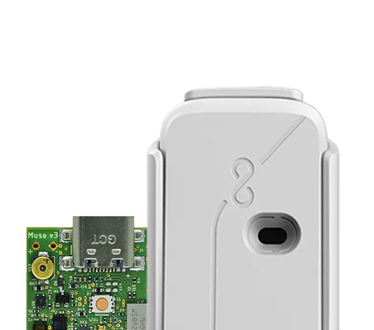
Measured with a Muse board, mounting a STM32WB55 MCU @16MHz
Case Studies
NeuraActive for Animal Tracking
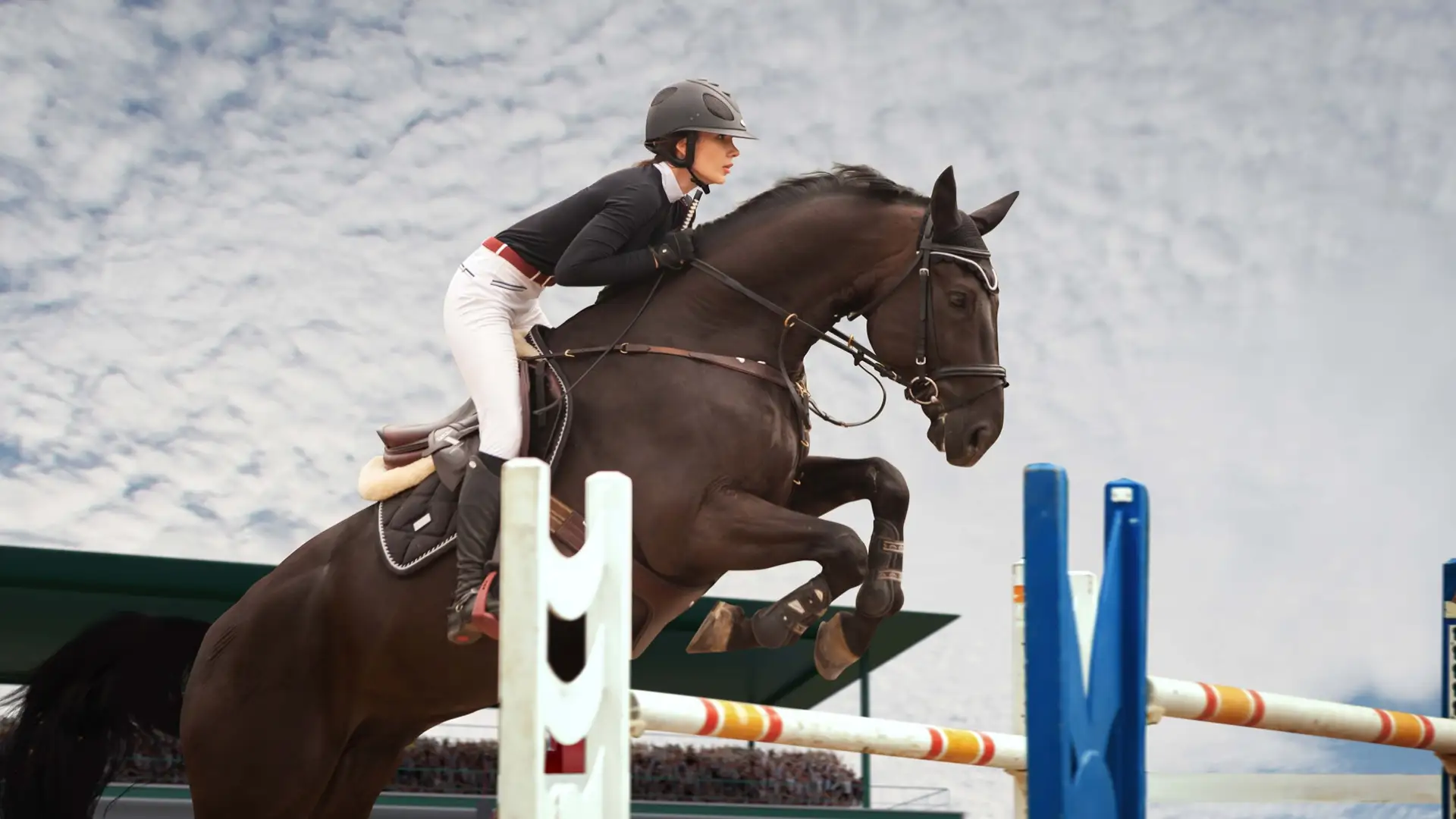
NeuraActive’s real-time motion analysis extends beyond human activity. Livestock monitoring, pet tracking, and horseback riding analysis, for example, use the same edge AI foundation to monitor animal movement patterns.
In livestock behavior monitoring, real-time motion data can help detect early signs of illness, stress or calving by identifying subtle deviations in herd movement patterns.
For pet tracking, intelligent activity monitoring makes it possible to track exercise levels, detect unusual inactivity and enhance safety through location-aware alerts. In equestrian performance monitoring, detailed gait and stride analysis supports rider training, performance optimization and injury prevention by providing objective biomechanical data.