

Most health problems do not begin with a crisis. They begin with a change in how the body moves.
A small shift in gait. A subtle tremor. A gradual loss of postural stability. Individually, these signals are easy to miss in a short clinical visit. Tracked continuously over days and weeks by a well-engineered wearable system, they become early warnings that can change the course of care.
This article explains how modern wearable biomedical sensors, built on inertial measurement, sensor fusion and edge AI, detect health changes earlier and more reliably than traditional monitoring methods. It also explains why the quality of the underlying technology determines whether a sensor system produces clinical insight or just data.
Early Detection Requires Richer Data
A patient attends a clinic appointment, undergoes a brief assessment and leaves. The clinician sees a snapshot taken under controlled conditions, usually when the patient is performing at their best. What happens throughout the rest of their day, on the stairs, in the garden, during the fatigue of a long afternoon, stays invisible.
Many conditions that affect movement, balance and neurological function worsen gradually: Parkinson’s disease, gait disorders, post-stroke motor impairment and age-related frailty. In each of these cases, the earliest indicators are subtle changes in motion quality such as shorter stride length, increased sway or asymmetric limb movement. These changes do not show up in a blood test. They appear in how the body moves.
That is the core problem wearable biomedical sensors exist to solve. Not to replace clinical judgment, but to give clinicians and care teams the continuous, real-world motion data they need to exercise that judgment earlier and with greater confidence.
How IMU-Based Biomedical Sensors Detect Early Change
At the heart of most wearable health systems is an Inertial Measurement Unit, or IMU. This is not a simple step counter. A properly engineered IMU combines accelerometers, gyroscopes and often magnetometers to measure the full three-dimensional motion of the body with high temporal resolution.
This level of detail allows a sensor to characterize movement in clinically relevant ways:
- Gait cycle analysis: stride length, cadence, stance and swing phase durations, step symmetry
- Balance and postural sway: center-of-mass drift, sway velocity, response to perturbation
- Tremor characterization: frequency, amplitude and temporal pattern of involuntary movement
- Turning dynamics: time to complete a turn, number of steps required, trunk-limb coordination
- Activity quality: not just whether movement happened, but how well it was executed
This is what separates a medical-grade IMU sensor platform from a consumer wearable. 221e’s Muse miniaturized multi-sensor IMU was designed from the ground up for this level of precision: small enough for comfortable long-term wear, low-power enough for continuous use and accurate enough to earn Class I Medical Device certification through the VIKTOR neurorehabilitation program.
Muse does not simply log data. Paired with 221e’s MPE (Motion Processing Engine), it performs real-time orientation estimation, exercise cycle detection and gait analysis directly on the device. The sensor fusion and embedded AI run at the edge, on the hardware itself, rather than sending raw data to a remote server for processing.
That distinction matters clinically. Edge processing means lower latency, no dependency on connectivity and the ability to act on motion data in real time. In applications like VIKTOR’s functional electrical stimulation system, where the device must respond within milliseconds to the patient’s movement cycle, this is a clinical requirement rather than an engineering preference.
Why Continuous Monitoring Outperforms Spot Checks
A clinical assessment captures one moment in time. Continuous wearable monitoring builds a longitudinal record of how a patient actually moves through daily life, across good days and bad, under fatigue and stress and varying environments.
That longitudinal record is where the clinical value lies. It can reveal:
- Whether walking speed is declining week-on-week, even when the patient reports feeling “about the same”
- Whether instability appears primarily in the morning, after fatigue or in specific environments
- Whether a rehabilitation program is producing measurable improvement in movement quality, beyond what a patient can self-report
- Whether a treatment adjustment correlates with improved gait metrics
- Whether fall risk indicators are accumulating before any fall has occurred
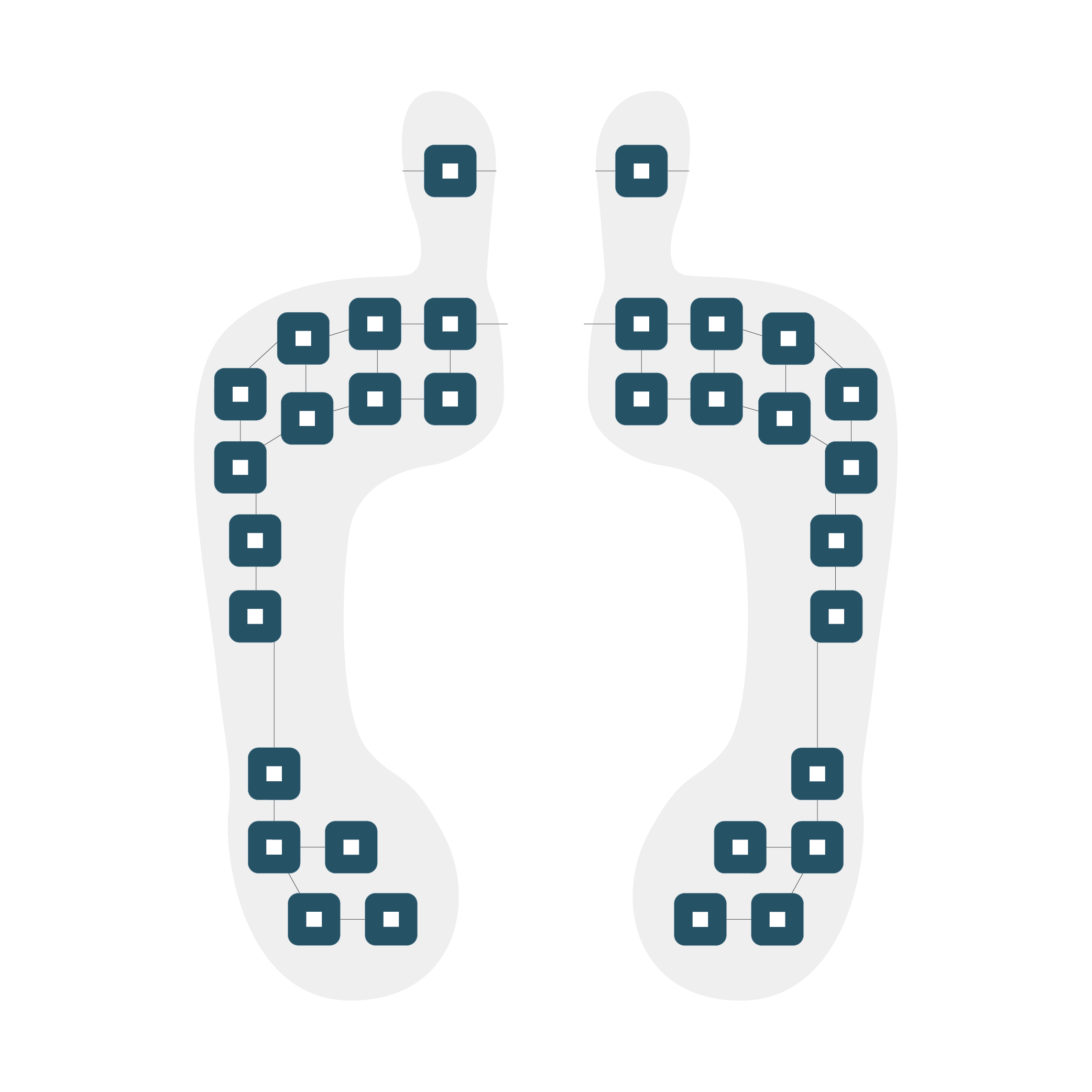
Building systems that maintain this data quality across long wear periods and variable real-world conditions is precisely what determines clinical value. 221e’s physics-informed feature extraction and expert-in-the-loop model development produce algorithms that remain stable across sensor positions, body types and activity variations in ways that purely data-driven models often cannot match. The Mitch research sensor platform extends this into formal clinical research settings, supporting multi-sensor configurations, add-on modules like the YETI foot pressure insole and structured data acquisition for longitudinal studies.
The Working Relationship Between Inertial Sensors and Edge AI
Raw IMU data is not health insight. The gap between sensor output and clinical meaning is bridged by algorithms that run on the edge, and the quality of those algorithms is what separates useful biomedical sensing from expensive noise.
221e’s approach centers on physics-informed AI: machine learning models constrained and guided by the known physics of human motion. For engineers and product developers, this produces several concrete advantages over generic deep learning frameworks:
- Models that perform optimally on constrained embedded hardware without requiring cloud compute
- Better generalization from smaller, high-quality training datasets, critical in medical applications where large, labelled datasets are rarely available
- Greater interpretability: clinicians and engineers can understand why the system produces a given output
- More reliable performance across real-world variation in sensor placement, patient population and activity context
For business and product teams, the practical implication is simpler: systems built this way work reliably in the field, not just in the lab. That reliability is what enables regulatory approval and clinical adoption.
The software that makes this possible is 221e’s MPE (Motion Processing Engine). It processes raw motion data from the sensor and turns it into something clinically useful. In VIKTOR’s neurorehabilitation system, MPE had to detect exact moments in a patient’s movement in real time, with no margin for error, because each detection directly triggered a therapeutic response.
Built on top of MPE, NeuraSense is 221e’s broader edge AI library set, integrating inertial data with additional sensor modalities to build a richer picture of patient state. Within NeuraSense, NeuraActive handles activity classification and exercise recognition, while NeuraSafe covers fall detection and man-down alerting, particularly relevant in elderly monitoring and high-risk care environments.
How a Wearable Motion Sensor Finds Hidden Patterns
The clinical value of a wearable motion sensor is not in any single measurement. It is in pattern recognition across time.
A clinician observing a patient walk for thirty seconds sees a sample. A wearable system monitoring said patient across a week of normal daily activity captures thousands of movement events. From that data, patterns emerge that a brief assessment cannot reveal:
- Progressive reduction in gait speed over a four-week post-surgical recovery
- Tremor that intensifies in the afternoon but is largely absent during morning clinic appointments
- Asymmetric loading between left and right limbs that worsens under fatigue
- Motor variability that increases ahead of a neurological episode
- Incomplete exercise cycles during home rehabilitation: adherence that looks compliant on paper but is mechanically deficient
What makes detection possible at this level of specificity is domain expertise embedded in the algorithm. Generic activity recognition models are not built to identify the subtle motion signatures of early Parkinson’s, post-stroke gait deviation or incomplete joint range in a rehabilitation protocol. That specificity requires the “experts in the loop” principle that defines 221e’s development process: biomechanical and clinical knowledge informing every stage of model design, not applied as an afterthought.
Where Biomedical Sensing Solutions Deliver Most Value
IMU-based wearable sensing delivers the most clinical value in settings where movement quality matters, where change happens gradually and where real-world data tells a fuller story than periodic assessment alone.
The strongest application areas include:
- Neurorehabilitation: motion-triggered therapy, exercise cycle monitoring and functional electrical stimulation control, as demonstrated in the VIKTOR Method using Muse and MPE
- Parkinson’s disease monitoring: gait analysis, tremor characterization and detection of motor fluctuations across the day
- Gait disorder diagnosis and tracking: quantitative, objective gait metrics for clinical assessment and longitudinal follow-up
- Fall risk detection: balance and stability metrics that identify high-risk patients before a fall occurs, supported by NeuraSafe
- Post-surgical recovery monitoring: tracking return-to-function and detecting deviations from expected recovery trajectories
- Chronic disease management: quantifying the physical impact of conditions like multiple sclerosis, osteoarthritis or heart failure on daily mobility
- Sports medicine and injury prevention: biomechanical analysis of movement quality to identify injury risk patterns before tissue damage occurs
Conclusion
Early detection in health is more of a signal quality problem than a data problem.
The body produces early warning signals for most of the conditions that place the highest burden on health systems. The challenge is capturing those signals with sufficient precision, continuity and intelligence to make them clinically actionable, before the problem becomes harder and more expensive to address.
IMU-based wearable sensing, combined with physics-informed edge AI and rigorous full-stack engineering, makes this achievable in production, not just in research settings.
That is the standard 221e designs to. For medtech companies looking to build on this foundation, explore 221e’s health and biomedical solutions or contact our team to discuss your specific sensing requirements.
FAQs
1. How does a wearable biomedical sensor detect health problems early?
By tracking motion signals continuously over time and identifying changes from established baselines. A single measurement tells you little. A week of gait, balance and activity data can reveal declining function, asymmetries or instability patterns that a brief clinical assessment would miss entirely.
2. Why is an IMU sensor important in wearable health devices?
An IMU measures three-dimensional motion including acceleration, rotation and orientation, with high precision. This enables quantitative analysis of gait quality, postural stability, tremor, exercise execution and movement symmetry. Many early-stage health changes manifest in movement before they appear in any other measurable signal.
3. What does ‘edge AI’ mean in a wearable biomedical sensor?
Edge AI means the computation that converts raw sensor data into meaningful health insight runs on the wearable device itself, not in the cloud. This eliminates latency, removes connectivity dependency and enables real-time response. In applications where the system must react to a patient’s movement within milliseconds, on-device processing is a clinical requirement.
4. What applications benefit most from IMU-based wearable sensing?
Conditions and care settings where movement quality is clinically meaningful and where longitudinal data provides more insight than periodic assessment: neurorehabilitation, Parkinson’s disease monitoring, gait disorder diagnosis, fall risk detection, post-surgical recovery tracking, chronic disease management and sports medicine.
5. How does 221e approach medical-grade sensor system development?
221e combines hardware design, physics-informed algorithm development and expert-in-the-loop AI training to build complete, production-proven sensing systems. The VIKTOR neurorehabilitation program is a clear example: Muse and MPE were developed, validated and deployed as an integrated medical-grade system, with Muse achieving Class I Medical Device certification. For companies that need this level of capability without building it from scratch, 221e’s MakeSense custom product partnership provides full-stack co-development support.