
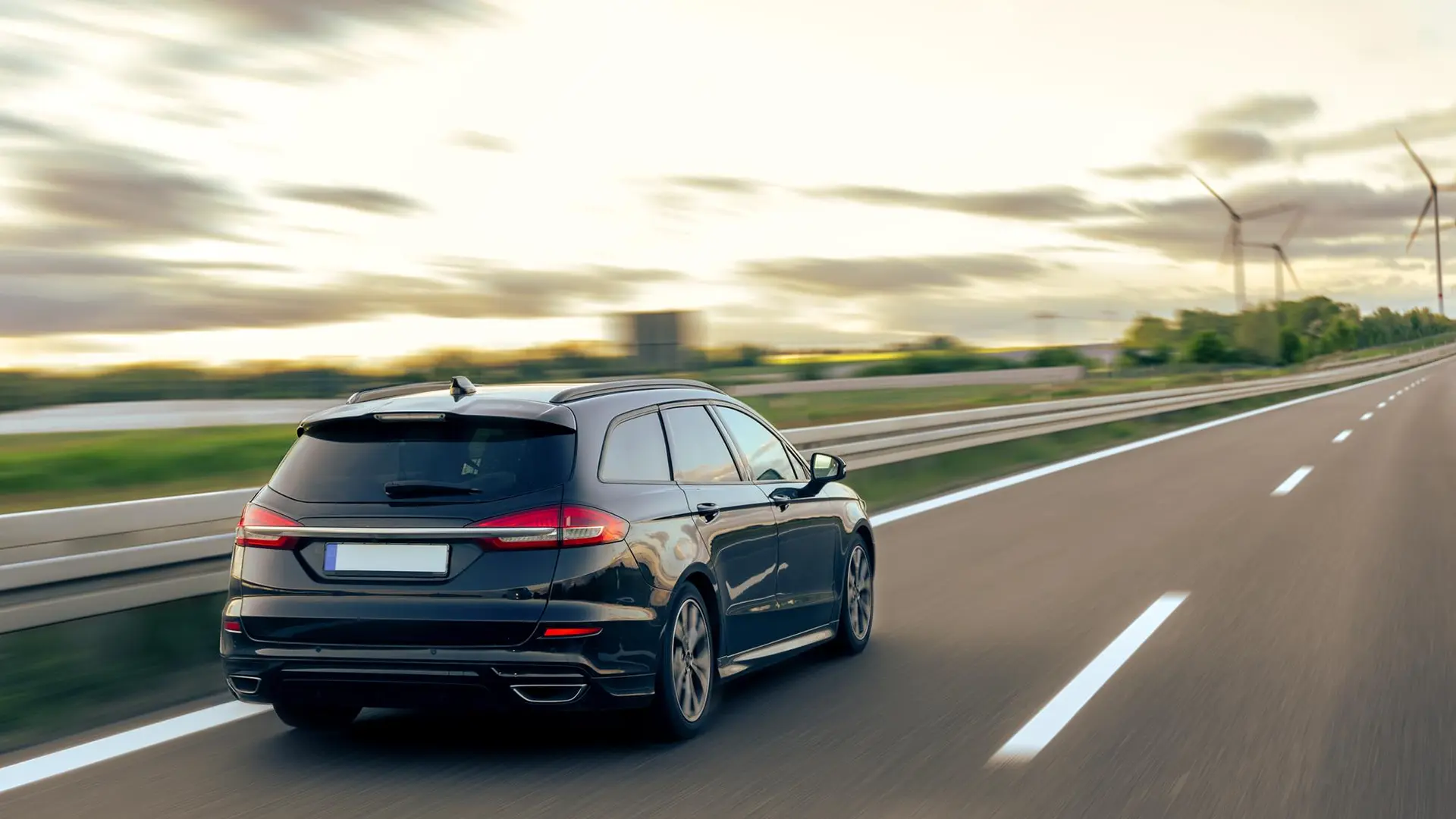
A driver turns into a fast corner on a damp track. Halfway through, the rear tires let go and the back of the car starts to swing out. A spin at this speed ends in the wall. But before the driver has even finished the thought “I’m losing it,” the car has already caught itself. One wheel has been braked a fraction harder than the others, the slide has been pulled straight and the car is tracking through the corner as if nothing happened.
Ask the driver afterwards what saved them and they will struggle to answer, because the save happened faster than they could think. It did not come from a camera reading the track. It did not come from a map or a satellite or a signal sent up to some server and back. It came from the car feeling its own motion, deciding in an instant that something was wrong and acting before a human ever could.
That instinct, the car thinking for itself, is the most underrated thing in vehicle safety, and it does not live only in race cars. The same reflex is built into the family hatchback, the delivery van and the forty-ton truck. Understanding where it comes from explains a great deal about how safe vehicles are built, and why the industry’s favorite answer to safety, which is to pile on more sensors and more data, misses the point.
A Blink is All You Get
Here is the part that is hard to grasp until you put a number on it. The slide in that corner played out in under three tenths of a second (0.3s). That is faster than a blink. A blink takes roughly a third of a second (0.33s) from start to finish, so the whole emergency, the loss of grip and the correction, was over before your eyelids would have finished closing and opening once.
Now picture that happening at motorway speed. In the time it takes to blink, a fast-moving car travels a good chunk of the length of a football pitch. There is no time to send a question anywhere and wait for an answer. Whatever intelligence notices the problem and fixes it has to be sitting right there on the vehicle, reacting at the speed of the event itself. This is the single most important fact about vehicle safety, and almost everything else follows from it.
The Sensor That Feels Instead of Sees
Most of the sensors people associate with modern cars look outward at the world. Cameras watch the lane markings. Radar and LiDAR scan for obstacles. Satellite positioning tracks where the car sits on the map. They are powerful, and they share one weakness: each can be blinded. A camera is useless in glare, fog or behind a dirty lens. Satellite signal vanishes in a tunnel or between tall buildings. LiDAR struggles in heavy spray. The moment conditions turn nasty, which is exactly when you need them most, these sensors can go quiet.
There is one sensor that never does, because it is not looking at anything. The automotive inertial measurement unit, or IMU, feels the car’s own motion from the inside. It senses how hard the car accelerates and brakes, and how it leans, rolls and rotates. Think of it as the car’s inner ear, the same sense that lets you tell up from down with your eyes shut, or lets a cat twist in mid-air to land on its feet. Light, weather and signal mean nothing to it. As long as the car is moving, it is reporting the truth.
That is why inertial sensing has grown from a minor part, the chip that once just triggered the airbag, into something the whole safety system leans on. When the camera is blinded and the satellite drops out, the other systems do not cope on their own. They fall back on the motion data the IMU is still quietly producing.
What It Feels, and Its One Weakness
An automotive IMU tracks two things. It feels acceleration: the shove of braking, the pull of a corner, the jolt of a pothole. And it feels rotation: how the body leans, tips and turns. On their own these are just raw numbers, so they are combined with other signals such as the car’s speed and steering to build a clear understanding of what the vehicle is really doing.
The IMU does have one weakness. Left alone it slowly loses track of exactly where the car is, the way your inner ear gets dizzy after a spin. Small errors build up over seconds. To maintain accuracy, it is paired with other sources, such as the wheel sensors and satellite positioning, which keep nudging it back to the truth. This pairing is called sensor fusion: several imperfect signals blended into a single reliable picture, which is what turns raw motion data into something a safety system can rely on.
Why More Data is The Wrong Answer
Here is where the racing world has something to teach the technology world. A race engineer setting up a car does not need to have crashed a thousand times to know what the car will do. They understand the physics: how weight shifts, how grip builds and breaks, how the car rotates. That understanding is worth more than any pile of data.
The same is true for safety. The instinct across the industry is to throw more at the problem: more cameras, more data, bigger models running in the cloud. For ordinary driving that mostly works. But the events that truly injure people, the rollovers and the awkward-angle impacts, are rare. They almost never happen, which is wonderful for the world and awkward for any system that learns only from examples. You simply cannot collect enough rollovers to teach a model what one feels like.
A system built on physics comes at it from the other side. It already knows how a vehicle moves, so it does not need a mountain of crash examples to recognize trouble. It holds up in exactly the rare, violent moments that matter most, and it is light enough to run on a small chip on the car rather than in a distant data center. In the moments that decide whether someone walks away, understanding the physics beats collecting the data.
The Racetrack and The Loading Dock
This is not just a story about thrilling saves on a circuit, because the business case lives here too.
Let’s imagine a delivery van taking a wet motorway off-ramp a little too fast, its load shifting in the back. Or a long-haul truck on a mountain pass in the rain, where a slide risks not one vehicle but forty tons of momentum and everyone near it. The same instinct that caught the race car catches these too, braking individual wheels and steadying the vehicle before the driver could ever react. For the operators running those vehicles, that is the difference between an ordinary Tuesday and a serious incident.
And the same sensing earns its keep long after the near-miss is over. Because the IMU is already on every vehicle and feeling its every move, that motion data tells a fleet a great deal: which drivers brake and corner harshly, which vehicles are being worked too hard, even which ones have worn suspension starting to show in the way they ride. That is a job for vehicle and driving monitoring edge AI. No cameras in the cab, no extra boxes to fit. One embedded sensor, already there, doing double duty as a safety system and an operational nervous system for the whole fleet.
Why It Has To Think on The Car
There is a catch that makes all of this harder, and it is why the cloud cannot do the job. A sharp sideways jolt could mean three completely different things. It might be an emergency swerve around a pedestrian. It might be an enthusiastic driver enjoying a corner. Or it might be the first instant of a rollover. The raw numbers look almost identical. Telling them apart, and choosing the right response, takes context. That thinking, which is performed by edge AI, has to happen instantly, on the vehicle, while the event is still unfolding.
The cloud is just too far away. By the time data travelled to a server and an answer came back, the moment would be long gone. On top of that, privacy rules in many places limit how much detailed driving data can be streamed off a vehicle at all. So, the intelligence lives where the action is: on a small chip, next to the sensor, reacting at the speed of the road.
The part worth remembering
If we strip away the technology, the story is simple. The decisions that keep people safe in a vehicle happen faster than a blink, and they are won or lost by how well the car understands its own motion in that instant. Not by how many cameras it carries or how much data it has seen, but by the quality of that inner sense and the intelligence wrapped around it.
For anyone building vehicles or running a fleet, that is where the real safety lives: in the sensor that feels rather than sees, and in the physics-trained intelligence that turns a single jolt into the right decision, in the only moment that counts.