
Across industries, demand for accurate, real-time motion analytics is accelerating. Companies seeking to integrate smarter embedded systems often ask the same question: How can a device understand complex motion instantly and reliably, without relying on the cloud?
The answer lies in combining IMU sensor fusion with advanced edge AI, forming the foundation of physical AI systems that can perceive, reason and act directly in the real world. By enabling on-device intelligence, this approach delivers high accuracy, ultra-low latency and consistent reliability for robotics, wearables, industrial automation and next-generation mobility.
Why IMU Sensors and Edge AI Matter
Modern automation faces a challenge at the heart of physical AI: obtaining precise motion data with near-zero delay. Cloud processing introduces latency that many systems cannot tolerate, especially robotics, drones, healthcare wearables and AR/VR platforms.
Through IMU sensor fusion, data from accelerometers, gyroscopes and optional magnetometers is blended into a stable, reliable representation of movement. When combined with embedded edge AI solutions like NeuraSenseTM, analysis is both immediate and precise, a feat that is near-impossible with traditional tools.
Inertial Sensor Fusion Enables Real-Time Precision
Many users wonder why a single sensor can’t capture full motion accurately. In certain scenarios, like vibration monitoring or impact detection, an accelerometer alone may be enough. But every sensor has its own limitations, including noise and drift. Accelerometers measure linear acceleration, while gyroscopes track angular rotation. For more complex applications, combining multiple sensors is essential to capture a complete and reliable picture of motion.
By intelligently merging multisensor outputs, solutions like MPETM (Motion Processing Engine) IMU sensor fusion apply advanced IMU sensor fusion to remove noise, reduce drift and produce stable orientation data. This allows devices to track movement even during high dynamic motion or vibration-heavy scenarios. The result is vastly improved accuracy compared to relying on a single type of IMU sensor.
Why Processing Requires Sensor Fusion Software
MPE provides a high-quality data foundation upon which NeuraSense can build motion insights. With MPE fusing sensor data to become stable and comprehensive, allowing the edge AI algorithms operate far more effectively and produce consistent results. Without robust preprocessing, system accuracy becomes questionable.
Precision is essential for modern motion-sensing devices. MPE is engineered to deliver highly accurate 3D orientation estimation while minimizing power consumption. By integrating proprietary Kalman filtering and advanced fusion techniques, it maintains accuracy that rivals optical ground truth, even in magnetically noisy environments or during dynamic movement.
IMUs in Modern Devices
People often ask: What exactly does an IMU sensor do?
An IMU sensor is the hardware component responsible for capturing raw motion data. It continuously collects readings that reflect how the device is moving, rotating or experiencing force.
Its performance directly affects everything from effective rehabilitative programs to robot stability and drone navigation. With only raw IMU outputs, however, the data can prove too noisy to use. This is why intelligent processing, filtering and contextual interpretation become essential and why the sensor – edge AI partnership matters.
When garbage goes in, garbage comes out. Sensors that are more susceptible to drift tend to give way to spurious or unstable data streams. Low-grade components can introduce bias, temperature sensitivity, higher noise floors and faster long-term degradation. All of these issues accumulate at the data layer: if the signal is compromised before it ever reaches your algorithms, even the most sophisticated models will spend their time fighting physics rather than extracting meaning.
Stronger hardware translates into:
- More accurate gait, posture and motion analysis
- More reliable vibration and anomaly detection
- Better predictive control in automation
- Faster, safer real-time decisions
How Edge AI Turns IMU Data into Smart Decisions
A common misconception is that IMU data can simply be collected and processed later. For many systems, timing is critical and many applications that depend on motion data cannot tolerate delays. A wearable detecting a fall, a robot stabilizing a joint or a drone correcting trajectory cannot wait for cloud processing. This is a defining requirement of physical AI, where perception and action must happen in real time.
Edge AI Eliminates Cloud Dependency
With edge AI:
- IMU outputs are fused, filtered and interpreted locally
- Decisions are made in real-time
- Devices maintain functionality even without connectivity
- Privacy improves naturally because raw data stays onboard
- Bandwidth usage decreases
This approach also delivers measurable business and industrial advantages. By shifting computation from servers to the device, companies reduce the infrastructure required to support fleets of smart tools, robots or machines. Cloud infrastructure expenses drop because less data must be transmitted and stored, so systems scale more efficiently as product lines expand. In industrial settings, local processing minimizes downtime, which translates directly into reduced maintenance costs. As a result, integrating IMU data with edge AI is not simply a technical upgrade, it becomes a strategic advantage that improves reliability, reduces cost and speeds innovation.
Robotics IMU and the Push for Better Motion Intelligence
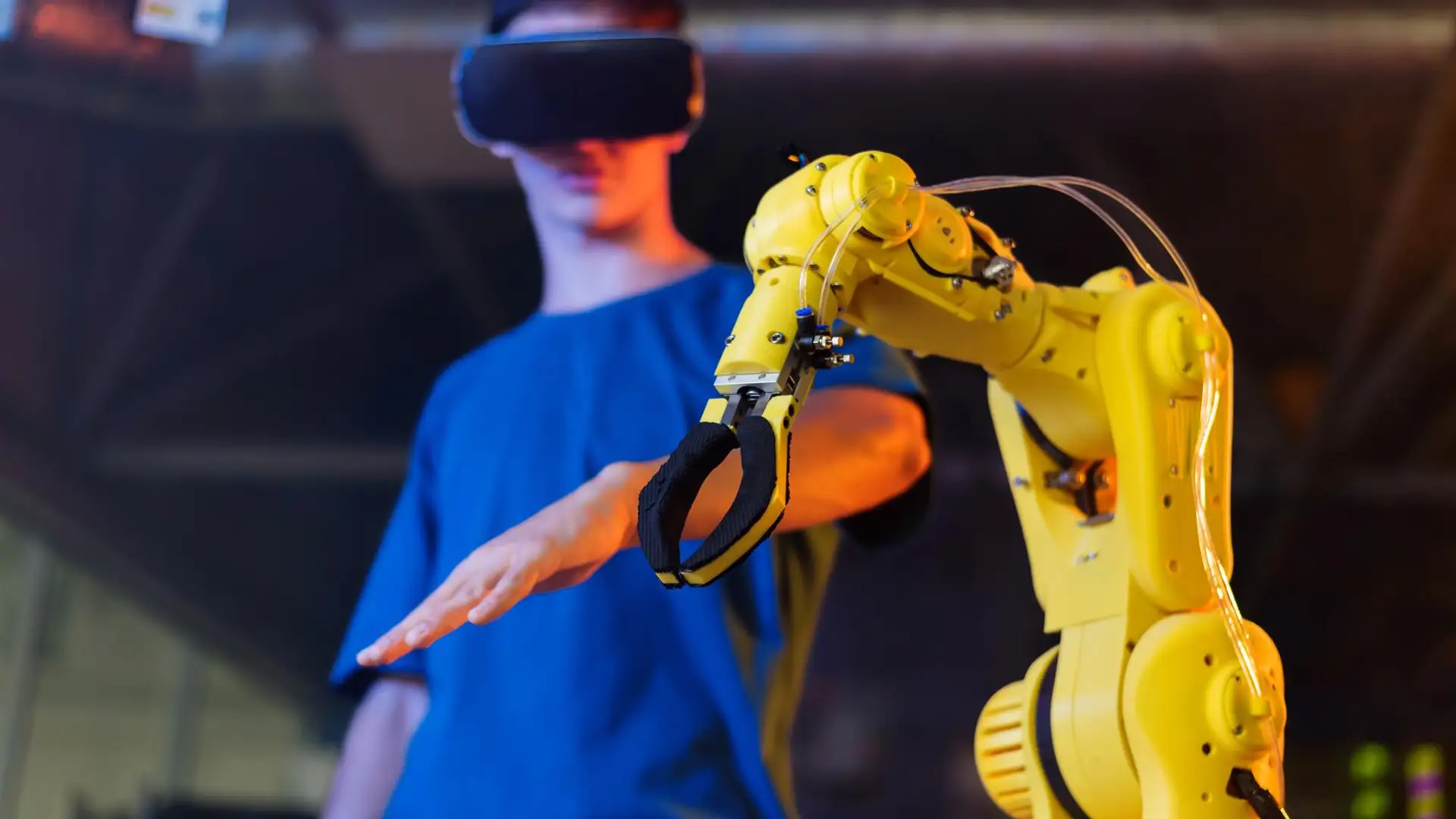
In robotics, precision is everything. A robot arm that hesitates, sways or misinterprets movement can become a safety risk or damage products. Industrial equipment and processes rely on IMU technology to ensure stable motion calculations and operations.
As robotics move towards physical AI, systems rely on real-time tracking and edge AI-based interpretation. Robots have a better “feel” of their surroundings and can operate with smoother trajectories, better balance and more predictable behavior. The integration of intelligent IMUs allows robotic systems to adapt to unexpected shifts in their environment.
How do IMU Sensor Fusion and Edge AI Work Together for On-Device Intelligence?
This pipeline represents a typical physical AI workflow, where sensing, interpretation and action occur locally. To understand the collaboration clearly, think of it this way:
- The IMU sensor captures raw acceleration and rotation data.
- Sensor fusion algorithms clean, stabilize and unify the data.
- Edge AI interprets the fused data and predicts actions or states in real time.
- The system reacts instantly, adjusting movement, compensating for instability or triggering an event.
This workflow enhances autonomy, reduces cumulative error and improves long-term performance.
Real-World Use Cases That Answer Common User Questions
Here are the most popular real-world cases where people ask how movement intelligence works:
1. Robotics & Drones: Smart IMUs help robotic arms move smoothly and predictably. In drones, sensor fusion & edge AI stabilize flight even with wind disturbances.
2. Smart Helmets & Wearables: Instant fall detection and posture correction rely on accurate IMU data.
3. Industrial Machines: Predictive maintenance & anomaly detection through real-time vibration analysis.
4. AR/VR: Millisecond head-tracking and reduced motion sickness due to low-latency orientation updates
FAQs:
1. Why is IMU sensor fusion better than single-sensor data?
Fusion removes offset errors, drift, and noise, resulting in more accurate orientation.
2. What makes edge AI essential for motion processing?
It processes data instantly on the device, avoiding cloud delays.
3. Can IMU-based systems work offline?
Yes, with on-device computing, they function without internet connectivity.
4. Why is IMU technology crucial in robotics?
It ensures stability, accurate movement prediction, and safer operation.
5. How does sensor fusion improve wearable devices?
It enables precise posture, fall detection and activity monitoring.
Build Smarter Physical AI Systems, Starting at the Edge
Unlock real-time, on-device motion intelligence with 221e’s sensor fusion and edge AI solutions. Our experts help you reduce latency, improve reliability and accelerate innovation, whether your business is developing robotics, wearables or industrial systems.
Talk to our team to see how IMU sensor fusion and edge AI can power your next round of physical AI products.