
In applications ranging from wearable diagnostics to structural health monitoring, the ability to capture, process and interpret motion data has become a critical engineering requirement. Inertial data loggers represent a mature yet rapidly evolving technology that addresses the fundamental challenge of autonomous, high-fidelity motion capture in real-world environments.
For engineers and researchers working at the intersection of sensing technology and data-driven decision making, understanding the capabilities and limitations of modern inertial measurement systems is essential. These systems form the foundation for smarter product design, predictive maintenance and advanced performance analysis across industries.
Technical Foundation: How Inertial Data Loggers Work
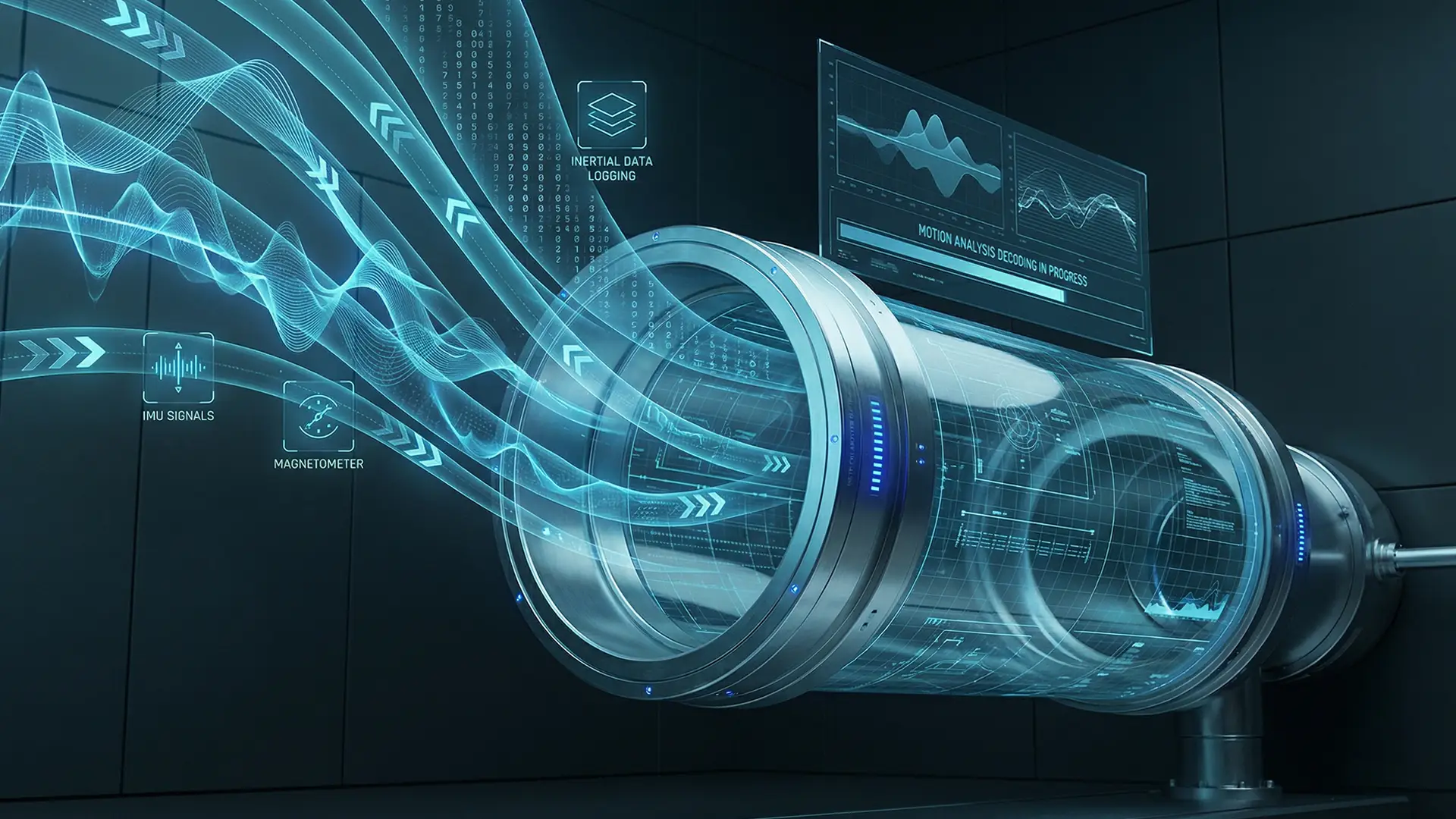
Inside the Core Sensor Array
Accelerometers measure linear acceleration across 3 axes. Beyond detecting dynamic motion, accelerometers sense gravitational acceleration, enabling static orientation determination.
Gyroscopes measure angular velocity around each axis, providing rotation rate data independent of gravitational reference. This makes them especially useful when a device is spinning quickly or operating in places where gravity-based sensors might get confused.
Magnetometers function as 3-axis digital compasses, measuring the strength of a device’s ambiental magnetic field. While sensitive to electromagnetic interference, magnetometers provide absolute heading reference that prevents drift accumulation that is inherent to gyroscopic integration.
The Inertial Data Pipeline
Modern inertial loggers operate through a sophisticated processing chain:
High-frequency sampling – Contemporary systems sample at rates from 100 Hz to 1,600 Hz or higher, capturing transient events that lower-rate systems miss.
Onboard processing – Advanced sensing devices implement sensor fusion algorithms and edge AI processing locally, reducing data volume and enabling real-time feature extraction.
Non-volatile storage – Onboard flash memory enables autonomous operation for extended deployments without continuous connectivity.
Flexible data retrieval – Modern connectivity options (BLE, USB, WiFi) support both post-processing workflows and real-time monitoring applications.
How Inertial Data Loggers Drive Smarter Engineering
Deployment Flexibility: The autonomous nature of data loggers eliminates infrastructure dependencies that constrain traditional measurement systems. Battery-powered operation and onboard storage enable deployment in remote locations, on shifting platforms or within sealed structures where continuous communication is impractical or impossible.
Temporal Resolution: These devices capture fast, short-lived events that determine system behavior in many applications. Measuring vibration signatures in rotating machinery or gait abnormalities in clinical assessment requires the ability to resolve millisecond-scale events and provide insights unavailable from lower-rate systems.
Objectivity and Repeatability: Automated data capture removes observer to enable standardized measurement protocols. This is particularly valuable in research contexts where reproducibility matters, and in industrial applications where consistent quality assessment is required across multiple sites or operators.
Scalability: The compact form factor and decreasing cost of inertial sensors enabledata collection. Distributed sensor arrays (networks) can characterize spatial variation in vibration, track how components move together or monitor different areas of the body for comprehensive human movement analysis.
Case Study: The Muse Sensor Platform
The Muse sensor from 221e exemplifies current capabilities in compact inertial logging. Engineered to fit snugly in your palm, it integrates a complete sensing and processing system suitable for applications where size constraints are critical.
Software Engineering Differentiators
Edge AI Processing: The onboard NeuraSense™ edge AI engine processes sensor data locally, enabling feature extraction and classification without cloud connectivity. This architecture reduces bandwidth requirements, improves response latency and addresses data privacy concerns in sensitive applications.
Sensor Fusion: The MPE™ Motion Processing Engine implements sophisticated sensor fusion algorithms that combine multi-sensor data to produce accurate orientation estimates while compensating for individual sensor limitations and environmental disturbances.
Field Validation: With over a decade of deployment history and certifications for EMC and electrical safety, the platform has demonstrated reliability in demanding real-world environments including medical facilities and the industrial sector.
Application Domains
Structural Health Monitoring: Inertial sensors deployed on bridges, buildings and industrial structures capture vibration signatures that indicate structural integrity. Changes in modal frequencies, damping characteristics or response to ambient excitation can signal damage or degradation before visible symptoms emerge.
Predictive Maintenance: In rotating machinery, vibration analysis using inertial sensors enables condition-based maintenance strategies. Bearing wear, shaft misalignment and imbalance all produce characteristic frequency signatures detectable through spectral analysis of accelerometer data.
Wearable Health Technology: Clinical gait analysis, activity recognition and fall detection leverage inertial sensing to quantify human movement. The combination of high sampling rates and sophisticated processing enables discrimination between similar activities and detection of subtle movement abnormalities.
Vehicle Dynamics Analysis: Automotive and aerospace engineers use inertial loggers to characterize vehicle motion during development and testing. Six-degree-of-freedom (6 DoF) motion data supports suspension tuning, stability system validation and accident reconstruction.
Where Inertial Data Logging is Headed
Several sensing tech trends are expanding the capabilities and applications of inertial data loggers:
Enhanced edge AI: Sophisticated onboard processing that enables complex classification and anomaly detection without external computing resources, supporting truly autonomous sensing systems.
Ultra-low power operation: Advances in MEMS technology and power management are extending deployment durations from weeks to months or years, enabling new applications, for example, in wildlife tracking and long-term infrastructure monitoring.
Integration with complementary sensing: Fusion of inertial data with GNSS positioning, environmental sensors and physiological measurements creates comprehensive situational awareness for complex applications.
Wireless sensor networks: Co-ordinated multi-node deployments enable motion sensing and analysis across extended structures or areas.
Conclusion
Inertial data loggers have evolved from specialized research instruments to versatile platforms capable of supporting diverse engineering and scientific applications. The combination of miniaturization, increased processing capability and advanced sensor fusion enables measurement scenarios that were impractical or impossible with previous generations of sensing technology.
As platforms like the Muse sensor demonstrate, current technology provides remarkable capability in compact packages, capability that continues to expand with each generation.
The question for innovation managers is now how to optimally integrate these capabilities into products and research programs to extract maximum value from inertial data. As edge AI continues to advance and deployment costs continue to decline, the strategic question becomes: what insights are we missing by not measuring motion in our systems? Let’s explore how our ML experts can accelerate your next project, contact 221e today.